Retain the distinctions within an older building
Lime rendering in Knutsford | Older walls and repairs
Older buildings can contain several periods of wall construction and repair. A later extension, a hard patch around an altered opening and an original rendered face may all sit beneath one painted colour. Lime work in Knutsford should recognise those distinctions. The specification needs to suit the actual fabric and condition, while any property-specific heritage requirements are checked separately. A traditional appearance alone does not establish either the correct material or the extent of repair.

On this page
Identify what is original, altered and uncertain
Begin with the areas proposed for work and the information available about them. Earlier photographs, material records and visible repairs can help an assessment, but they may not reveal every layer. Where uncertainty matters to the specification, controlled investigation should be appropriate to the building and avoid unnecessary disturbance. The purpose is to inform treatment, not to expose every surface simply to produce a uniform new start.
A house and detached outbuilding may have different construction even if they appear similar. Within one building, altered openings and later additions can also change the background. Keep those areas distinct in the scope. The house rendering guide explains how separate specifications can sit within a coordinated project without pretending that every wall shares one history.
- Stone or brick masonry Cleaned of loose material and dampened so it does not draw water out too fast.
- First (scratch) coat Often haired; scratched to give the next coat a key.
- Second (floating) coat Applied once the first has firmed up; follows the line of the wall.
- Finish coat Thin final coat, kept damp and shaded while it cures.
- Limewash or mineral paint Optional decoration that keeps the wall permeable.
Wall on the left, finish on the right. Not to scale: coats, thicknesses and primers follow the chosen manufacturer’s system and the condition of the wall.
Check heritage records for the actual address
Cheshire East publishes individually named conservation-area maps associated with Knutsford, including the town area and other separate designations. Official listed-building records also apply to particular entries. Those sources should be checked for the property and proposed work; neither the place name nor proximity to a designated building gives a complete permission answer.
Heritage status and material compatibility are connected considerations, but they are not interchangeable. A map does not specify the render mix, while a suitable material choice does not establish that consent requirements have been met. Where relevant, obtain the appropriate advice before finalising removal, repairs or a change of appearance. The eventual quotation should reflect the agreed scope and any applicable requirements.
| Decision | What informs it |
|---|---|
| Required consent | The actual property, designation and proposed work |
| Material compatibility | Wall construction, existing layers and condition |
| Repair extent | Sound retained fabric and the causes of failure |
| Finished appearance | Appropriate texture and compatible decoration |
Consider the wall and all its layers together
SPAB's guidance explains why lime and cement renders can behave differently on traditional construction. The appropriate choice depends on the masonry, mortar, exposure and existing materials. Different lime products are not universal substitutes for one another. A specification should be developed with relevant expertise rather than selected from a general belief that an older date always means one particular mix.
The final coating also matters. Suitable lime render beneath an incompatible paint is not automatically a coherent arrangement. Identify retained coatings and establish the appropriate decorative treatment. A breathable description on a label is not enough to prove compatibility with every wall. If a colour change forms part of the brief, it should follow the material assessment rather than override it.
Decide whether removal would cause more harm
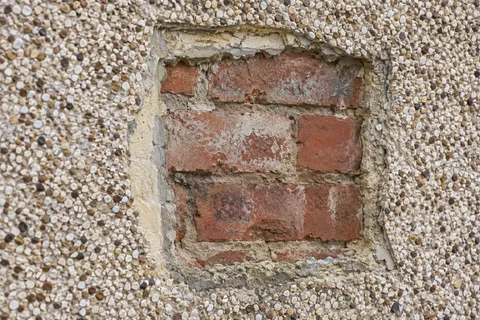
Hard later render may be undesirable in some circumstances, but stripping it can damage softer masonry where the bond is strong. The assessment should weigh the consequences of removal against those of retention and repair. A controlled trial may help establish an appropriate method and the condition beneath. Its result should inform the next step before extensive work proceeds.
This is especially relevant where pebbledash removal is being considered for appearance. The coarse surface does not reveal the composition or attachment of the underlying layers. Removing it should not be sold as a reliable way to uncover attractive original masonry. The background may need compatible repairs and a new finish, with the extent decided from evidence rather than an assumed decorative outcome.
Where only part has failed, local repair may preserve more sound fabric. The technical repair boundary should follow condition and an appropriate method. If a consistent colour is desired across the elevation, consider the suitable decoration separately. That avoids enlarging removal solely to chase an appearance that could be addressed through a different compatible finishing decision.


Resolve water sources and adjoining work
Rainwater defects can repeatedly wet the same part of a wall. If a gutter, downpipe or other detail is contributing to deterioration, it needs attention within the wider project. A new lime finish should not be expected to make an ongoing leak harmless. The relevant trade should identify and complete the necessary work before the surface is finished.
Windows, roof junctions and other attachments also need coordination. A sound repair can be damaged shortly afterwards if a planned frame replacement was never included in the programme. Establish the sequence and protection appropriate to the building. Access should remain available for the stages that need it, including the specified curing and inspection requirements.
Agree an appropriate finish and keep its history
Review a representative sample for texture and any compatible colour treatment. Traditional material may not be intended to reproduce the appearance of an unrelated modern thin-coat system. Decide what existing irregularity remains and what correction is appropriate. This gives the finished work a realistic reference rather than a digitally smooth image that ignores the underlying wall.
Retain the repair locations, material specification and final coating information at handover. For one wall, a brief marked photograph may be sufficient to identify different treatments. The next maintenance decision can then begin from known information rather than infer the wall's construction from its latest colour. A good lime-render project preserves both suitable fabric and a clear understanding of what has been changed.
Common questions
Does a conservation-area address automatically require one lime product?
No. Designation and consent questions need to be checked for the proposed work, while the material specification must suit the actual building. A boundary map does not identify its masonry, previous repairs or appropriate mix. Relevant conservation and technical advice should inform the project.
Can lime repairs be limited to part of an elevation?
Where the assessment supports compatible local repair, retaining sound material may be appropriate. The scope should identify the affected area and the intended visual result. A broader decorative treatment can be a separate decision rather than a reason to remove otherwise sound fabric.
See housing and planning information for Knutsford and nearby places, including the source and geography behind each figure.